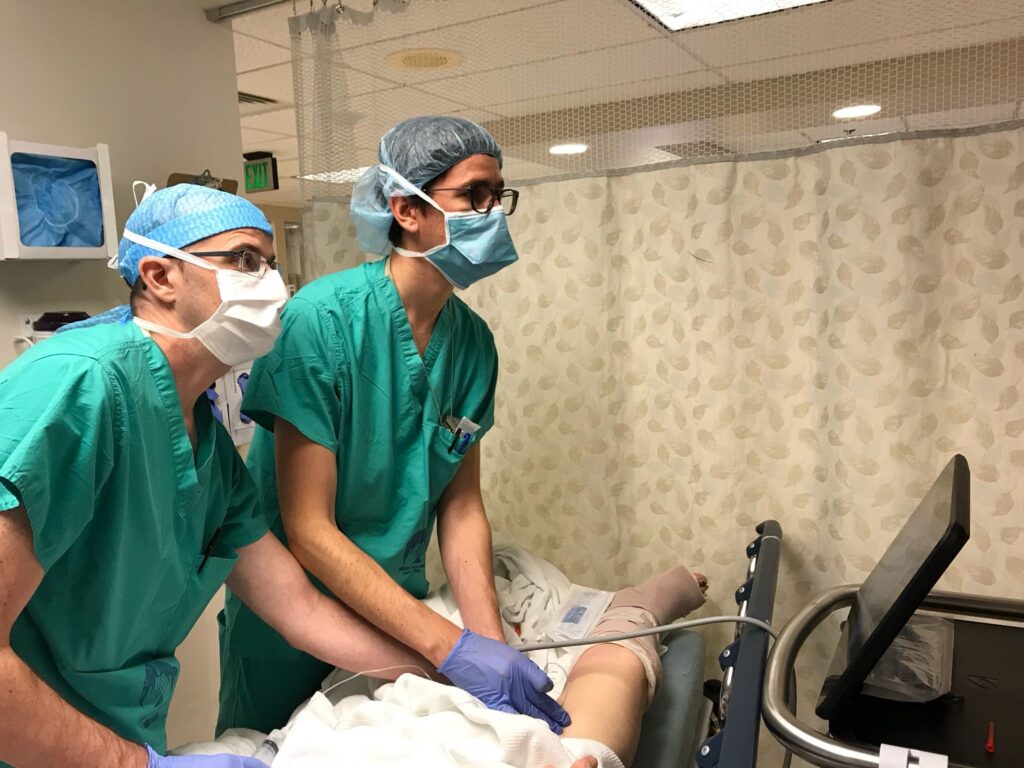
The goal of the Regional Anesthesiology & Acute Pain Medicine Fellowship is for fellows to develop the skills and knowledge base necessary to perform basic, intermediate, and advanced regional nerve blocks. Fellows have ample opportunity to take part in research initiatives and attend national conferences. A robust basic and advanced didactic program is offered which spans in topics from the basics of ultrasound to acupuncture and medical marijuana for pain management. In addition, all fellows have access to the online regional anesthesia resource “Anesthesia Toolbox”, online textbooks with JHU library, and a hard copy Fellow Library which contains books such as Dr. Hadzic’s Textbook of Regional Anesthesia and Essentials of Regional Anesthesia.
ACGME Accredited: Yes
Duration of Program: 1-year advanced clinical training
Positions Available: 5
Applicant Qualifications: Successful completion of an ACGME-Accredited Anesthesiology Residency or via the Exceptionally Qualified Applicant Pathway for non-ACGME international certified Educational Commission for Foreign Medical Graduates (ECFMG) from Anesthesiology.
Application Process and Timeline: We participate in the San Francisco (SF) Match. Applicant registration opens in January for the following years’ fellowship class (1.5 years prior to matriculation). Applications are accepted through April 15th, and virtual interviews are offered via Thalamus GME through the first week of May. Match day is in early June.
Participating Hospitals: Johns Hopkins Hospital (downtown campus) & attached Johns Hopkins Outpatient Center, Bayview Medical Center, & Howard County Ambulatory Surgery Center.
Start Date: Flexible between July – August
Visas Accepted: We accept J-1 visas, and more information can be found on our Office of International Affairs website J-1 ECFMG Information.
Eligibility
Successful completion of:
- ACGME-Accredited Anesthesiology Residency
- ECFMG certified applicants from:
- Either an ACGME International (ACGME-I) or the Royal College of Physicians and Surgeons of Canada (RCPSC) accredited programs
- Non-ACGME-I, Non-RCPSC anesthesiology training programs by going through the additional "Exceptionally Qualified Applicant Pathway" and are approved by the Johns Hopkins Graduate Medical Education Committee
- The Exceptionally Qualified Applicant packet must be submitted with their application and include score reports from USMLE Step 1-3. Request Exceptional Applicant
- Following the interview, if determined by the program to be a potential good fit for the fellowship, this packet and application are submitted to the Johns Hopkins Graduate Medical Education Committee for approval. This process can take up to 4 weeks.
- Candidates must be approved before they can be listed on a rank list in SF Match or extended an offer for an off-cycle position.
Additional Requirements for all potential fellows:
- Must be eligible for a Maryland medical license or to be registered in Maryland as an unregistered medical practitioner.
- Must pass a criminal background check.
- Must successfully complete the Johns Hopkins Credentialing process and be approved for clinical duty by the Johns Hopkins Medical Staff Office.
Application Process
All applicants must register with the San Francisco Matching Program (information can be found on www.sfmatch.org), which opens in January in the year prior to matriculation.
Please include the following with your SF Match application submission:
- Minimum of 3 letters of recommendation
- One must be from their residency training program director verifying successful completion of training at the time of application. Applicants currently enrolled in a training program must have verification of successful completion provided prior to starting the fellowship.
- Medical school transcripts, performance evaluation, and diploma
- Updated CV
- Personal Statement (in SF Match Format)
- Scores, number of attempts, and outcome of all USMLE Step 1-3 exams, as well as any In-Training Exams and ABA Basic
- For ECFMG applicants:
- ECFMG certificate
- Residency proof of ACGME-I or RCPSC accreditation or the completed “Exceptional Candidate Pathway” packet
- Any international credentialing exam dates and scores
Applications will be reviewed only after receipt of all required materials to the SF Match. Applications are accepted through April 15th.
Interviews
- Interviews are granted on a first-come, first-serve basis until interview slots are full. All interviews are virtual at this time and are offered via Thalamus GME through the first week of May.
Match
- In some cases, you may be eligible to commit to a program with an exception agreement, after registration on SF Match. These agreements are initiated by the program director and not the applicant and are due mid-May.
- ALL rank lists must be submitted by 12:00 PM (noon) PT on the posted deadline on SF Match. After the deadline, rank list choices will be locked, and no changes can be made.
- Match Day when results are reported in early June.
Post-Match Vacancies and Off-Cycle Applicants
If our program doesn't fill all five positions in the SF Match for a given year, we will post the number of vacant positions on SF Match, the American Society for Regional Anesthesia and Pain Medicine (ASRA) Fellowship Directory and this website.
- Requirements for off-cycle applicants include all of the same elements as above to be emailed with the completed ASRA Common Application for Regional Anesthesiology to the Program ([email protected]) or via SF Match Vacancies Portal.
- Completed applications are reviewed any time after the SF Match has completed up until January 15th for matriculation to start in July/August of the same year. This time is required for processing and credentialing in time for the academic year.
Objectives
The Advanced Training in Regional Anesthesia and Acute Pain Program is an accredited one (1) year advanced training program. The goals are organized according to the ACGME core competencies.
Professionalism
Fellows are expected to:
- Act responsibly and with integrity with their patients, nurses, residents, fellows, and health care providers.
- Fulfill clinical duties in a timely and appropriate manner.
- Adhere to ethical principles including respect for patient privacy.
- Demonstrate an active interest in learning and participating in the care of patients receiving regional anesthesia.
Interpersonal and Communication Skills
As advanced trainees, fellows will be expected to interact and communicate effectively with patients, nurses, nurse anesthetists, surgeons and attending anesthesiologists, residents, medical students, and other trainees. They will refine their skills in educating and preparing patients for the regional nerve blocks or other interventional acute pain procedures. Fellows are expected to:
- Provide effective patient education regarding indications, risks and side effects of procedures.
- Obtain appropriate informed consent from patients, paying special attention to identifying laterality for unilateral procedures.
- Communicate effectively with other members of the team.
- Initiate and appropriately conduct a pre-procedure “timeout.”
- Properly and accurately document in the medical record any procedures performed.
- Provide education to more junior members of the care team, including residents, medical students, junior perioperative nurses, and other trainees.
Medical Knowledge
By the end of training, fellows will demonstrate expert knowledge in the following areas:
Medical Management of Acute Pain:
- Local anesthetic pharmacology, toxicity, and appropriate clinical usage in peripheral, neuraxial, and systemic analgesia, and use of adjuvants.
- Appropriate use of opioids (systemic and neuraxial) in treating acute pain states, and implications related to their side-effects.
- Advanced management of acute pain with multimodal analgesics, including understanding the pharmacology of NSAIDs, COX-2 inhibitors, NMDA antagonists, α2-agonists, α2δ-Ca2 channel blockers (i.e. gabapentinoids).
- Management of patients with chronic pain and chronic opioid use/ abuse.
- Direct the acute pain medicine service with attending supervision.
Interventional Management of Acute Pain
- Nerve localization techniques, including principles of ultrasound and nerve-stimulation technologies, and other localization methods (i.e. hanging drop, loss of resistance, landmark techniques).
- Methods, rational, and appropriate application of single-shot and continuous catheter techniques.
- Applied functional regional anatomy as relevant to the surgical procedure and/ or block technique employed, including positioning patients for performing blocks.
- Appropriate use of procedural sedation when performing interventional procedures.
- Appropriate patient selection for and choice of interventional nerve blockade.
- Recognition and management of complications related to interventional acute pain management (i.e. hemodynamic compromise, local anesthetic toxicity).
- Upper extremity blockade, including:
- Cervical plexus
- Brachial plexus (Interscalene, Supraclavicular, Infraclavicular, Axillary)
- Distal extremity nerve block
- Truncal blocks, including:
- Paravertebral
- Quadratus Lumborum
- Transversus Abdominus Plane
- Pecs 1, 2, and Serratus Plane
- Lumbar and thoracic epidural anesthesia/ analgesia
- Lower extremity blockade, including:
- Lumbar Plexus
- Femoral
- Saphenous/adductor canal
- Sciatic (proximal and distal approaches)
- Ankle
- The art and science of spinal anesthesia and associated side effects.
- Appropriate postop management of peripheral nerve and epidural catheters to achieve effective pain control.
Practice-based Learning and Improvement
During training, fellows will further develop an understanding of and apply critical analysis of the relevant primary source literature relevant to the various acute pain phamacotherapeutic modalities, including regional nerve blockade techniques. Fellows will also moderate and lead a monthly Journal Club on topics relevant to the specialty.
Patient Care
By the end of the advanced training fellowship, graduating fellows will be expected to independently:
- Assess patients’ appropriateness for placement of peripheral or neuraxial nerve blocks.
- Setup and properly position patients for peripheral nerve blocks
- Select appropriate procedural sedation based on patient and/or procedure factors
- Select the appropriate nerve localization technique using nerve stimulation vs. ultrasound vs. landmarks
- Select alternative approaches to perioperative pain control in non-traditional patient populations (i.e. chronic pain, anatomical variants, infected patients, low weight patients, etc.)
- Manage block failures (single-injection and/ or continuous catheter techniques)
- Perform and complete peripheral nerve and neuraxial procedures
- Medically manage surgical patients’ acute pain in the perioperative period (pre-, intra-, and post-op)
- Provide expert patient care recommendations as a consultant in Acute Pain Medicine to requesting medical and surgical specialists
- Counsel patients on appropriate modalities of pain management in the acute setting
Systems-based Practice
The fellow will develop an awareness of and responsiveness to the needs of the large health care system as it relates to the acute pain patient receiving regional anesthesia, both as a primary anesthetic and for postoperative analgesia. He/she will also understand the rationale for and participate in hospital initiatives to improve quality and efficiency in the operating room as it pertains to acute pain medicine and regional anesthetic techniques.
- Work effectively as a member of and with the patient care team.
- Understand basic principles of safety in administering regional nerve blocks.
- Identify areas for quality improvement in the administration of acute pain and regional anesthesia.
- Understand the documentation of regional nerve block and acute interventional pain procedures.
Assessments
The fellow will receive electronic evaluations by the Division of Regional Anesthesia and Acute Pain Management, in addition to verbal feedback during his/her clinical performance. Fellows will maintain a procedure log that will be evaluated quarterly or more frequently, as needed, by the fellowship program director for the number and type of nerve blocks or other regional anesthetic techniques to ensure they are obtaining adequate experience.
Additional Educational Opportunities
- Rotation with addiction medicine to learn more about inpatient vs outpatient therapy
- Protected research time to work on QI projects or IRB approved studies
- Joint Journal Clubs with University of Maryland and Walter Reed Hospital
- Cadaver lab workshop for JH residents at JHUSOM (led by Regional Division)
- Annual sonoanatomy/ultrasonography course in regional anesthesia for JH residents (led by Regional Division)
- Specialized rotation in Point-of-Care Ultrasound use in clinical care (cardiac echo, FAST, AAA, abdomen) done in conjunction with faculty from the JHU Department of Emergency Medicine. Additional “Bootcamp” day in July for a POCUS crashcourse introduction.
- Regular Journal Club (directed by fellows with faculty guidance)
- Fellow-directed specialty-topic discussions with residents on service
- Advanced lecture series including topics on Contract Negotiation, Private vs Academic Job searches, Program Building, Burn Pain Management, etc.
- Optional elective to do Pediatric Regional Anesthesia and Acute Pain at All Children’s in Florida
- Elective within Chronic Pain Division, access to daily high quality lectures
- Oral board seminar (well regarded, free, network with other fellows from different specialties)OSCE board prep in state of the art simulation center (well regarded and free for fellows)
- Optional Moonlighting as an attending in the Operating Room
For qualified applicants, a 3-year combined program geared for candidates interested in pursuing an advanced academic research track is available. With this program, the 1-year Acute Pain Medicine and Regional Anesthesia clinical fellowship is combined with 2-years of faculty-level research training made possible by the NIH-sponsored institutional T32 research training grant. This research training grant provides funding for 80% protected non-clinical time, and also offers an opportunity for sponsored advanced study. Prior T32 trainees have chosen to use their grant time to fully fund and complete a MPH degree in clinical investigation, for example, with the Johns Hopkins University Bloomberg School of Public Health. This unique program is designed for developing research leaders in Acute Pain Medicine and Regional Anesthesia. Candidates who are interested in this program should inform the program staff of this interest when applying.
- The Military Advanced Regional Anesthesia and Analgesia Handbook
- Acute Pain Management by Sinatra et al.
- Essentials of Regional Anesthesia by Kaye et al.
- Textbook of Regional Anesthesia and Acute Pain Management by Hadzic
- Acute Pain Management: A Practical Guide, 3rd ed by MacIntyre & Schug
- Ultrasound-Guided Regional Anesthesia and Pain Medicine 4th ed by Bigeleisen
- Mayo Clinic Atlas of Regional Anesthesia and Ultrasound-Guided Nerve Blockade by Hebl
- Pain Resource Center on the American Society of Regional Anesthesia and Pain Medicine (ASRA)
- Links to Other ASRA Resources
- Regional Anesthesia & Pain Medicine (official journal of ASRA)
Contact Information
Acute Pain Medicine and Regional Anesthesia Fellowship Program
Department of Anesthesiology and Critical Care Medicine
The Johns Hopkins Medical Institutions
Sheik Zayed Tower 8120L
1800 Orleans Street
Baltimore, MD 21287
410-955-1818
[email protected]

Fellowship Director
Kellie Jaremko, MD, PhD
Associate Program Director
Shruti Sudhakar, MD
Medical Training Coordinator
Beverly Thomas
[email protected]
2025-2026 Regional Anesthesiology & Acute Pain Medicine Fellows

Joon Ying Boon, MD, PhD

Ankit Kansal, MBBS
Arden Woods, DO