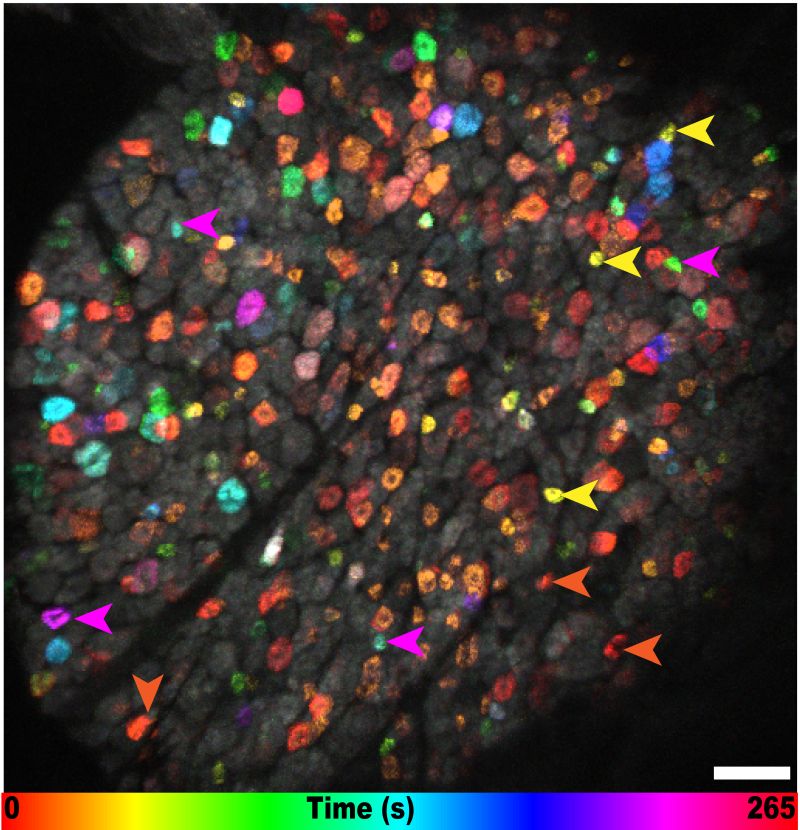
The Zheng Lab investigates how primary sensory neurons detect sensory stimuli and how their activity changes in chronic pain. We focus on the dorsal root ganglia (DRG), where sensory neuron cell bodies provide access to the peripheral signals that convey information from the body to the spinal cord. Our goal is to understand which neuronal populations contribute to different forms of pain and how their activity is altered by injury or disease.
A central approach in our research is in vivo calcium imaging, which allows us to observe activity across populations of sensory neurons in living animals. We combine imaging with genetic approaches, targeted manipulation of neuronal activity, and behavioral analysis to connect cellular mechanisms with sensory function. Our studies address spontaneous pain after nerve injury and abnormal mechanical and cold sensitivity associated with chemotherapy. By identifying the peripheral mechanisms underlying these symptoms, we aim to inform more selective approaches to pain treatment.
Sensory Neuron Diversity and Pain
Primary sensory neurons comprise diverse populations with distinct sensory functions. We investigate how these populations respond to mechanical and thermal stimuli and how their responses change under pathological conditions. By combining in vivo DRG imaging with genetic identification and manipulation of neuronal subtypes, we seek to determine which populations contribute to particular sensory abnormalities. This work links the functional diversity of sensory neurons to the symptoms experienced in chronic pain.
Peripheral Mechanisms of Spontaneous Pain
Pain can occur without an external stimulus, yet the peripheral activity associated with spontaneous pain remains incompletely understood. We study spontaneous activity in DRG neurons after nerve injury and investigate how interactions with the sympathetic nervous system influence this activity. Our approach combines population imaging with targeted interventions and behavioral measurements to examine the contribution of peripheral neuronal activity to ongoing pain.
Chemotherapy Induced Peripheral Neuropathy
Our NIH R01-supported research investigates how paclitaxel alters sensory neuron function and produces abnormal mechanical and cold sensitivity. We focus on identifying the neuronal populations involved and determining how their responses change during neuropathy. The project combines functional imaging with genetic and behavioral approaches to investigate mechanisms that may guide future strategies for preventing or treating chemotherapy-associated pain.
Principal Investigator
Qin Zheng, PhD
Assistant Professor
Department of Anesthesiology and Critical Care Medicine
Johns Hopkins University School of Medicine
Dr. Qin Zheng earned her Ph.D. in Neuroscience from Peking University in China. Her doctoral research examined the intrinsic electrophysiological properties and gene expression of dorsal root ganglion (DRG) neurons in bone cancer pain. She identified a critical role for Kv7 channels in the development of bone cancer pain and investigated the epigenetic mechanisms regulating their expression. Following her doctoral training, she joined Dr. Xinzhong Dong’s laboratory in the Department of Neuroscience at Johns Hopkins University School of Medicine as a postdoctoral fellow. There, she developed an in vivo calcium imaging approach that enables visualization of activity across large populations of primary sensory neurons in the DRG of living mice, expanding her research from the properties of individual neurons to sensory function at the population level. She joined the Department of Anesthesiology and Critical Care Medicine at Johns Hopkins as an Instructor in 2022 and became a tenure-track Assistant Professor in 2026. Her laboratory investigates sensory neuron function and the peripheral mechanisms of spontaneous and evoked pain across diverse experimental models, combining in vivo imaging with electrophysiological, genetic, molecular, and behavioral approaches.
Opportunities
Students and researchers interested in sensory neuroscience, in vivo imaging, and chronic pain are welcome to contact Dr. Zheng to discuss research interests and potential opportunities. We also welcome inquiries about scientific collaboration.
In vivo GCaMP Imaging Reveals Distinct Subsets of DRG Neurons Driving Spontaneous Pain After Nerve Injury in Mice. PAIN, 2026.
- Guan LC, Liu J, Luo Z, Jiang M, Zhang JM, Zheng Q. In vivo GCaMP imaging reveals distinct subsets of dorsal root ganglion neurons driving spontaneous pain after nerve injury in mice. Pain. 2026 Jul 28; PubMed PMID: 42520162
- Zheng Q, Xie W, Lückemeyer DD, Lay M, Wang XW, Dong X, Limjunyawong N, Ye Y, Zhou FQ, Strong JA, Zhang JM, Dong X. Synchronized cluster firing, a distinct form of sensory neuron activation, drives spontaneous pain. Neuron. 2022 Jan 19;110(2):209-220.e6. PubMed Central PMCID: PMC8776619
- Cai W, Zhang W, Zheng Q, Hor CC, Pan T, Fatima M, Dong X, Duan B, Xu XZS. The kainate receptor GluK2 mediates cold sensing in mice. Nat Neurosci. 2024 Apr;27(4):679-688. PubMed PMID: 38467901
- Kim YS*, Anderson M*, Park K*, Zheng Q*, Agarwal A, Gong C, Saijilafu, Young L, He S, LaVinka PC, Zhou F, Bergles D, Hanani M, Guan Y, Spray DC, Dong X. Coupled Activation of Primary Sensory Neurons Contributes to Chronic Pain. Neuron. 2016 Sep 7;91(5):1085-1096. PubMed Central PMCID: PMC5017920
- Liu X*, Wang H*, Jiang Y*, Zheng Q*, Petrus M, Zhang M, Zheng S, Schmedt C, Dong X, Xiao B. STIM1 thermosensitivity defines the optimal preference temperature for warm sensation in mice. Cell Res. 2019 Feb;29(2):95-109. PubMed Central PMCID: PMC6355819
Contact

Qin Zheng, PhD
[email protected]
Department of Anesthesiology and Critical Care Medicine
Johns Hopkins University School of Medicine
Baltimore, Maryland
1780 East Fayette St, Room 9127, Baltimore, MD 21231